
By Todd Jackson, SVP of Sales for Elliott Jets

When buyers begin evaluating business jets, the conversation often drifts toward extremes. Maximum range, highest cruise speed, or the largest possible cabin tend to lead initial conversations. Those attributes look compelling on paper, but in real‑world ownership, they are rarely the factors that define long‑term satisfaction.
In the used aircraft market, especially, one reality drives more successful transactions than any other: most business jet missions are short. Not occasionally short, but consistently so. Across private owners, corporate flight departments, and managed fleets, Aviation Week found that in 2025, the average business jet trip is just 2.25 hours.
These are regional business trips, same‑day turns, and high‑frequency routes that repeat week after week. While long‑range capability is valuable in certain cases, it often plays a smaller role in day‑to‑day utilization than buyers initially expect.
The aircraft that perform best in this environment are not necessarily the newest or largest. They are the jets that align closely with how owners actually fly. This alignment is why certain models continue to sell faster, retain value more effectively, and deliver fewer ownership regrets.
This article explores which business jets are best suited for under‑three‑hour missions, how those aircraft perform in the used market, and how they realistically compare to larger super‑midsize options that are often considered but not always needed.
Why Sub‑Three‑Hour Missions Dominate Business Aviation
Business aviation exists to eliminate inefficiencies. Owners use private aircraft to bypass airline schedules, avoid congested hubs, and gain access to airports that shorten door‑to‑door travel time. Most of that value is realized on regional routes.
Consider how aircraft are actually flown. A Northeast‑based company may fly repeatedly between New York, Boston, Washington, and Chicago. Texas operators often run Dallas, Houston, Austin, and Denver rotations. On the West Coast, Los Angeles, San Francisco, Las Vegas, and Phoenix dominate flight logs. These trips rarely press range limits, but they demand reliability, flexibility, and consistency.
Aircraft optimized for these missions tend to fly more frequently. Higher utilization leads to better economics, improved crew efficiency, and stronger resale outcomes. Conversely, aircraft selected primarily for long‑range capability often sit idle more than expected, which shifts ownership cost from justifiable to frustrating.
The used market reflects this clearly. Buyers become far more pragmatic after seeing how aircraft are truly operated. Specifications matter less than alignment with reality.
What Actually Matters for Frequent Short‑Range Flying
When evaluating jets for under‑three‑hour missions, decision‑making criteria shift. The focus moves away from maximum performance and toward repeatability and predictability.
Fully understanding the aircraft utilization is critical. Aircraft that closely match mission profiles tend to deliver higher satisfaction and fewer compromises. Paying for range or payload that is used once or twice a year increases acquisition and operating costs without improving daily usefulness.
Operating economics are magnified on short flights. Frequent missions mean fuel burn, engine cycles, and scheduled maintenance all accumulate faster. Predictable costs often matter more than theoretical efficiency.
Another underestimated factor is airport access. Many business destinations involve shorter runways, slot restrictions, or infrastructure limitations. Aircraft that can operate into these airports expand access and often save more time than any speed advantage.
Resale is the final, often overlooked, component. Jets that fit many business missions can be easier to sell when mission needs change. In the used market, flexibility when the aircraft no longer meets your mission should always be a factor in your decision.
Embraer Phenom 300

The Embraer Phenom 300 has become a reference point for modern short to mid‑range business aviation, largely because it excels where most owners need it to. For under‑three‑hour missions, the Phenom 300 offers an ideal balance of speed, efficiency, and dispatch reliability. It cruises fast enough to keep trip times competitive with larger aircraft while maintaining reasonable fuel burn and straightforward operations.
From a used‑ownership perspective, the Phenom 300 benefits from a large global fleet and a mature support network. Maintenance costs are well understood, parts availability is strong, and engine programs provide cost predictability. This reduces unexpected expenses and simplifies budgeting.
The cabin experience aligns well with the mission. For four to six passengers on short flights, the environment feels refined without excess. While it is not intended for long‑haul comfort, it rarely feels compromised on the missions it actually flies.
Resale value remains one of the Phenom 300’s strongest attributes. Clean aircraft with consistent maintenance histories tend to attract real buyers quickly, contributing to its continued strength in the used market.

Citation CJ2, CJ2+, and CJ3

The Citation CJ family remains one of the most practical solutions for short‑range business aviation. These aircraft were designed from the outset to emphasize efficiency, reliability, and simplicity.
The CJ2 and CJ2+ are particularly well-suited for one to two‑hour missions with modest passenger loads. They appeal strongly to first‑time jet owners and owner‑operators, offering manageable operating costs and straightforward systems. The CJ3 builds on that foundation by adding cabin space and performance margin without significantly increasing operational complexity. For many owners, it represents a comfortable step up while remaining firmly aligned with sub‑three‑hour flying.
In the used market, the CJ family benefits from extensive support infrastructure and a deep maintenance knowledge base. Acquisition costs remain manageable, and ownership expectations tend to be modest, rather than too much for the operator.
Cabin size is efficient, but for short trips, that efficiency is often more than sufficient. Passengers value reliability and convenience over sheer space on these missions.

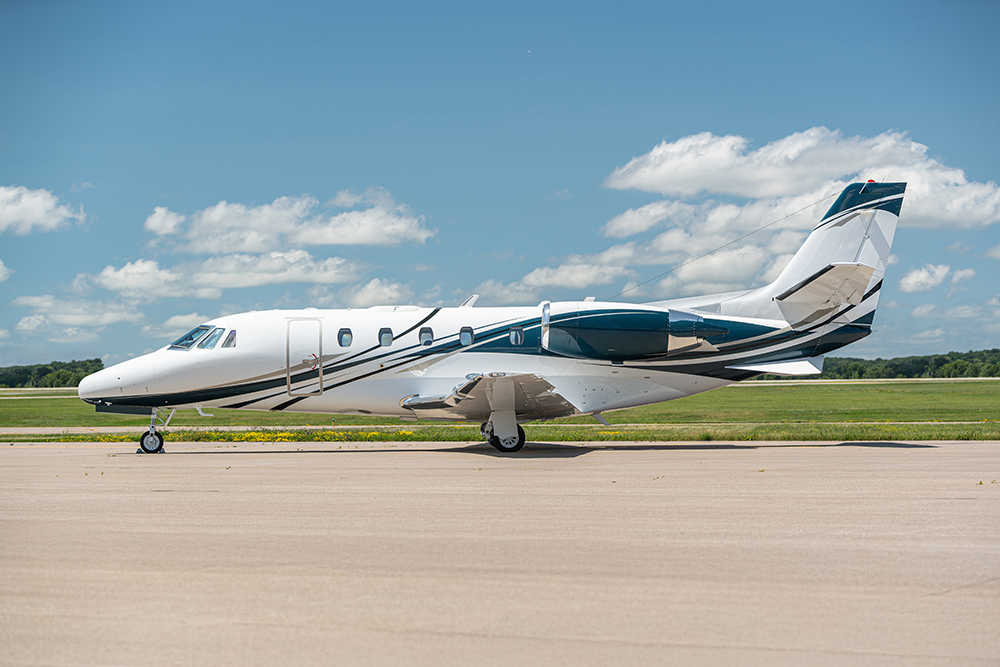
Citation Excel/XLS

The Citation Excel and XLS occupies a valuable middle ground for owners focused on short missions who want more cabin comfort than traditional light jets provide. For flights under three hours, the Excel/XLS delivers noticeably more space, which becomes particularly important for repeat passengers. While range capability extends well beyond what most short missions require, it is the cabin comfort that drives buyer interest.
In the used market, the maturity of the Excel/XLS is an asset. Maintenance support is widespread, operating costs are predictable, and ownership risk is relatively low. While operating costs exceed those of CJ‑series aircraft, the increase is incremental.
The cabin often becomes the deciding factor. On frequent short trips, additional comfort can outweigh marginal differences in speed or range. The Excel strikes this balance without pushing owners into super‑midsize economics.
Well‑maintained Excel aircraft continue to transact, reinforcing their reputation as dependable, mission‑appropriate workhorses.

How Super‑Midsize Jets Actually Stack Up on Short Missions

Super‑midsize jets are undeniably capable aircraft, and they are often considered during the buying process. The question is not whether they can perform short missions, but whether their added capability is being used. On longer flights, the advantages are clear. Larger cabins and greater range enhance comfort and operational flexibility. On sub‑three‑hour flights, however, those advantages diminish rapidly.
Fuel burn increases disproportionately relative to trip length. Maintenance complexity and ownership overhead rise, while cabin space can go underutilized. In some cases, airport access becomes more restrictive compared to smaller aircraft.
For owners who frequently alternate between short and long missions, a super‑midsize jet can be a great option. For those whose flying is overwhelmingly regional, these aircraft often represent too much airplane for the buyer. When considering a super-mid, one of the most productive questions a buyer can ask is not what the aircraft can do, but how often it will do it.

The Common Thread Behind Successful Aircraft Choices
Across these categories, one theme is consistent. The aircraft that perform best for buyers in the used market are optimized for common, repeatable missions. Jets like the Phenom 300, CJ family, and Citation Excel continue to succeed because they deliver predictable value. They fly often, cost roughly what owners expect them to cost, and remain attractive when it is time to sell.
Owners who buy an aircraft that matches reality rather than aspiration tend to experience fewer compromises and greater long‑term satisfaction.
Buying for Short Missions in the Used Market
Many buyers make the mistake that aircraft selection should be driven by capability rather than usage. This is especially true in the three‑hour‑and‑under mission category, where repetition matters more than range. Owners often remember the one long trip per year more vividly than the fifty short ones. That leads to aircraft being selected for edge cases rather than the day-to-day reality. Over time, this mismatch shows up in utilization rates, operating frustration, and resale outcomes.
From a brokerage perspective, aircraft that are optimized for short missions tend to enter the market with fewer complications. They have flown regularly, maintenance tends to be current, and owners usually understand what they are selling. Jets that were bought for theoretical missions often show deferred usage patterns and inflated expectations.
Final Take
The business jets that perform best for under‑three‑hour missions are not exciting because of what they might do someday. They are valuable because of what they do every week.
When aircraft selection reflects real behavior rather than aspirational scenarios, ownership becomes simpler, more predictable, and far more satisfying.
That is true on day one, and it is even more true on resale.
About the Author:
Todd Jackson started at Elliott Aviation in 1997 as an aircraft salesman and currently serves as Vice President of Acquisitions. After graduating from the University of North Dakota with a degree in aeronautical studies, Jackson spent five years selling air freight for a transportation company. As an active pilot with over 1,500 hours, he holds private, commercial, instrument, and multi-engine ratings. You can reach him at 612.382.0386 or tjackson@elliottjets.com.